
Blog
Originally published on Substack
The junk hauler who invoices in 4-5 minutes
Aaron Martynowicz runs Trash Panda, a junk hauling business in Dundalk. Removal, haul-away, disposal fees. The kind of work where the job ends with a truck full of someone else's problem and a client who needs the paperwork.
For a lot of his commercial clients, the invoice is the whole point of the transaction. They are not buying an experience. They need a piece of paper for their records, and the faster it arrives, the faster the money moves.
That is the getting-paid problem in its simplest form: the work is done, the client is willing, and the only thing standing between the two is a document that takes too long to make.
Paying for nothing
Aaron was invoicing through Square. Square's cut on a card invoice is 3.3% plus 30 cents, and that is before anything else. Here is the part that stung: Aaron takes Zelle, Venmo, and Cash App. No card processor. For the way he actually gets paid, the Square fee was money for nothing.
This is the wedge, stated plainly: if your customers pay by Zelle, check, or cash, you are paying a percentage of every invoice for a card machine you never use.
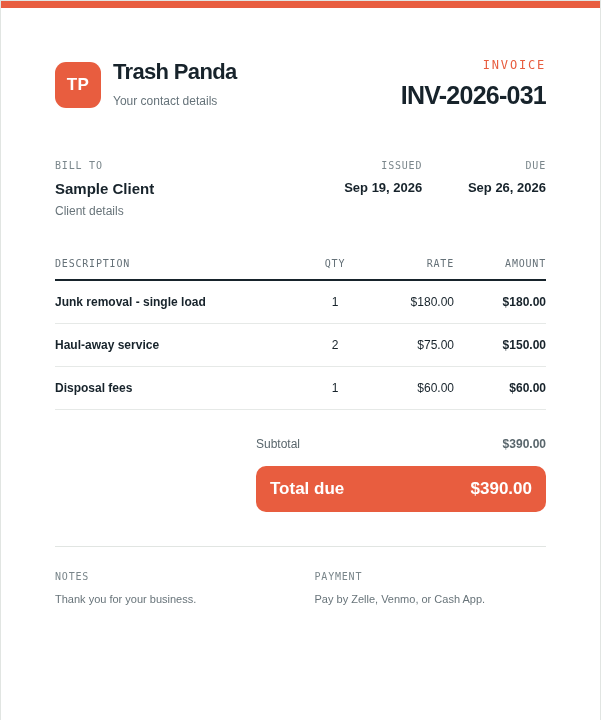
How Aaron actually gets paid: Zelle, Venmo, or Cash App. No card machine, no percentage cut.
The text-message test drive
On September 13, Aaron tried the MonkeeTools invoice generator live, over text messages with Brian. He did not get a sales pitch. He got a link, opened it on his phone, and started making an invoice.
What came back was blunt, useful feedback, and five fixes shipped the same day:
1. The logo was too small. It got enlarged, then enlarged another 40%.
2. He refreshed and lost his logo and settings. The remember prompt now fires right after logo upload and on settings close.
3. The header crowded on his phone and broke his email address mid-word. It now stacks vertically on mobile.
4. "Punch in their number and send it." That became the Text client button: it opens the SMS app with the number and the invoice text ready.
5. He asked for an app store version. The honest answer was the $99-a-year Apple fee was not worth it, so a donate button went in instead.
His verdict on the speed: "when I can type up an invoice and send it over in 4-5 minutes that's great." And: "It was simple to make an invoice. It was a quick process."
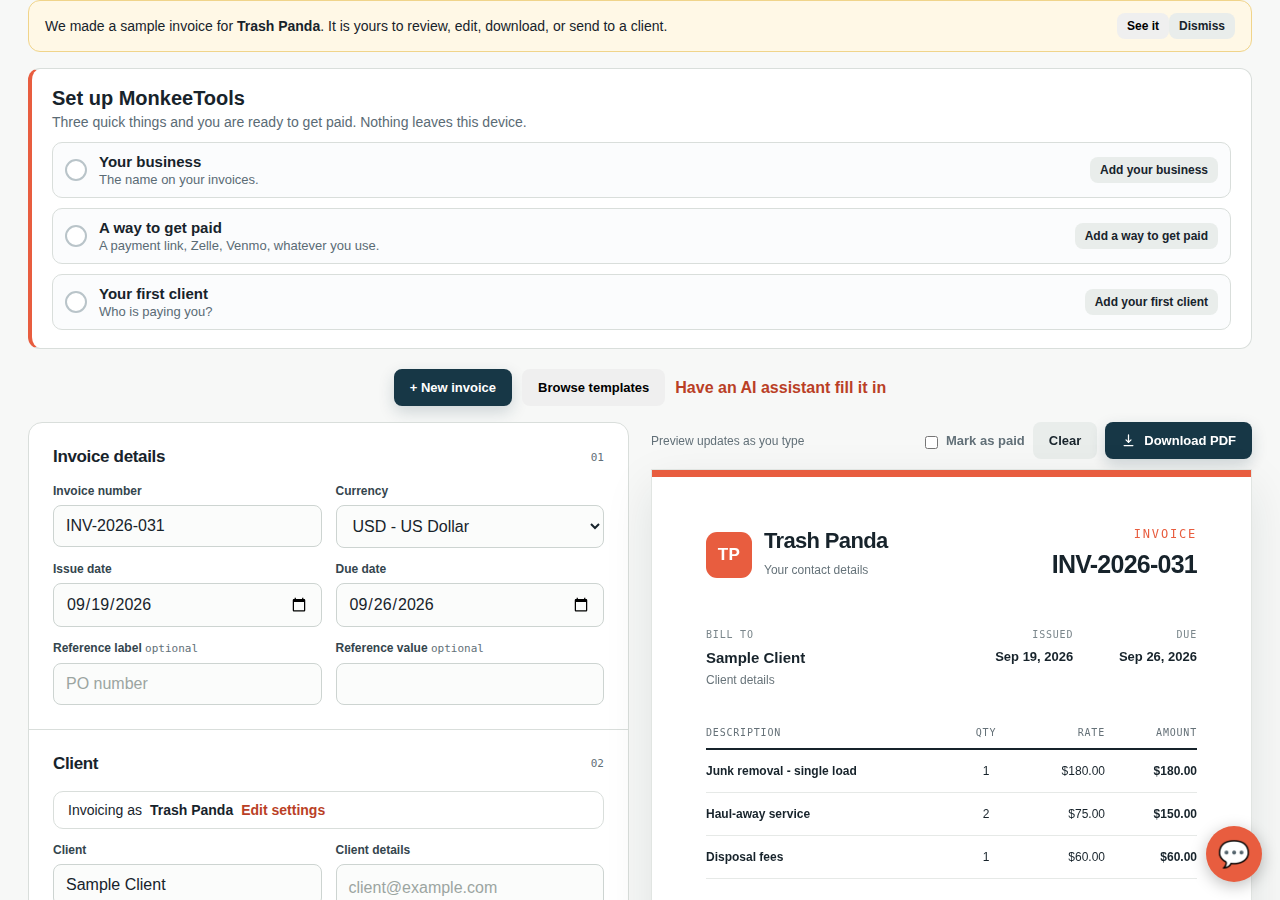
The generator with a Trash Panda junk-hauling invoice: three line items, live preview, no signup.
What he actually liked
The quotes that made the /freelancers/ page, used with his permission:
"It's an invoice making tool. It's beneficial to business owners. It's easy to use. Once we got through the settings it was really good. I'm going to use it."
And the second one, which now sits on the tool pages: "I love that none of my data is stored on their server."
Read those together and the pattern is obvious. No login, which he liked. No verification step. No account holding his business data on someone else's server. For a guy who hauls junk for a living, the invoice tool should work like his truck: turn the key, go.
His business even shaped the product. The junk-hauling trade template, removal, haul-away, and disposal fees pre-loaded, exists because Aaron's business needed it. He is also the reason the Text client button exists.
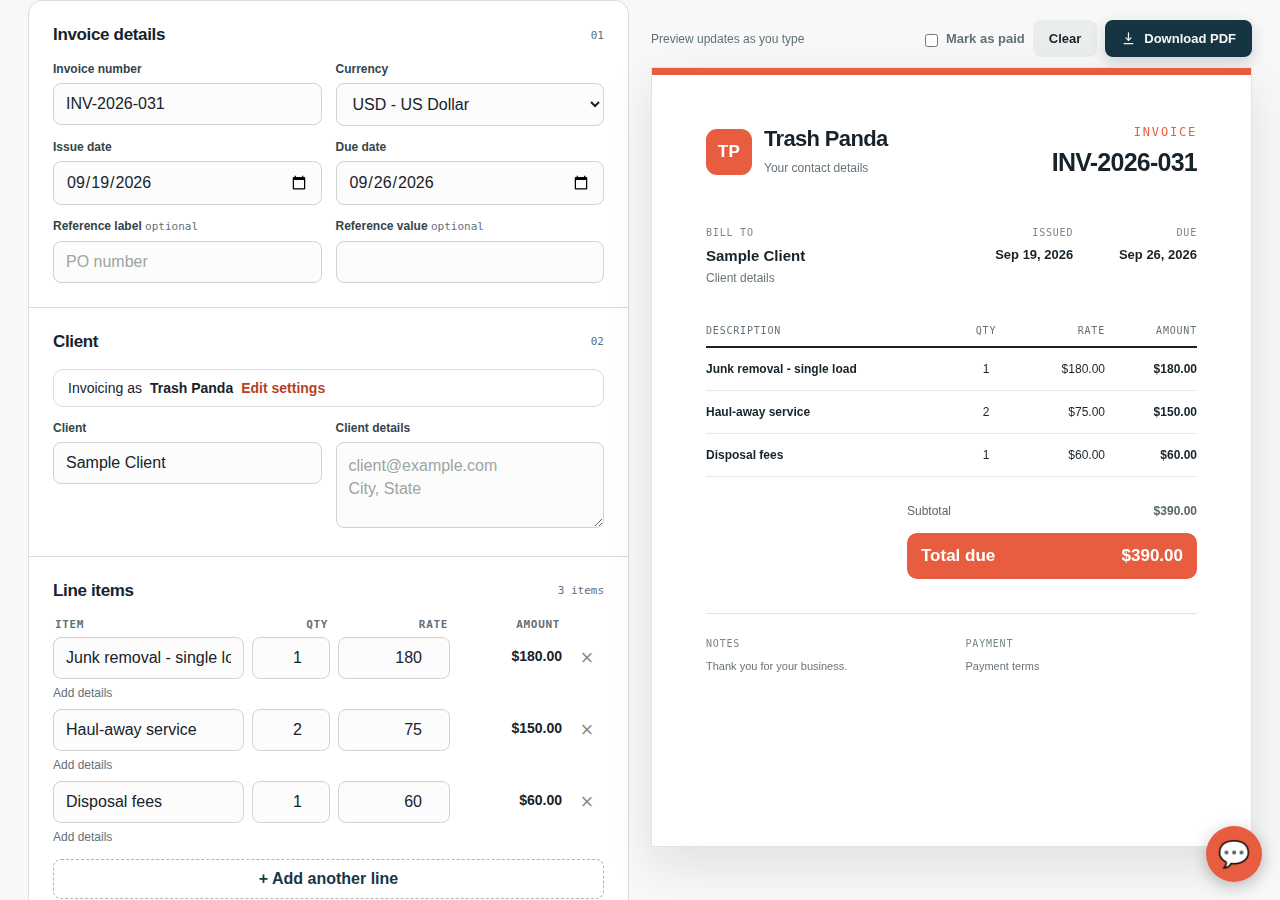
Three line items, $390.00 total. This is the paperwork that used to be a chore.
Where it stands
Aaron committed to using MonkeeTools for Trash Panda, and on September 17 he accepted the invitation to become a design partner, which means his feedback keeps steering the product.
The honest version of this story: the tool did not make Aaron's clients pay faster. His clients were never the problem. It took the paperwork from a chore to a four-minute task, cut out a fee he was paying for nothing, and gave him his afternoons back. For a one-truck business, that is the whole game.
Get new posts by email.
One post a week: honest build logs and leverage-through-technology pieces for freelancers and bootstrapped founders. No spam, unsubscribe anytime. Subscribe on Substack.