
Blog
Originally published on Substack
Invoice Teardown #1: The invoice that waited until the work was done
Invoice Teardown is a new series. Every edition takes a bad invoice and walks through it line by line, showing exactly why it will get paid late, then shows the fixed version. Friendly, never mocking. This one is real: a freelancer posted this week. Names and identifying details removed.
The story
A web developer finished an $800 website, sent the invoice for the remaining $500 after delivery, and the client went silent. Weeks later: no reply, no payment, and a finished site the developer no longer has any leverage over.
The invoice itself is not the problem. The problem is everything that was never written down before it. Here is the teardown.
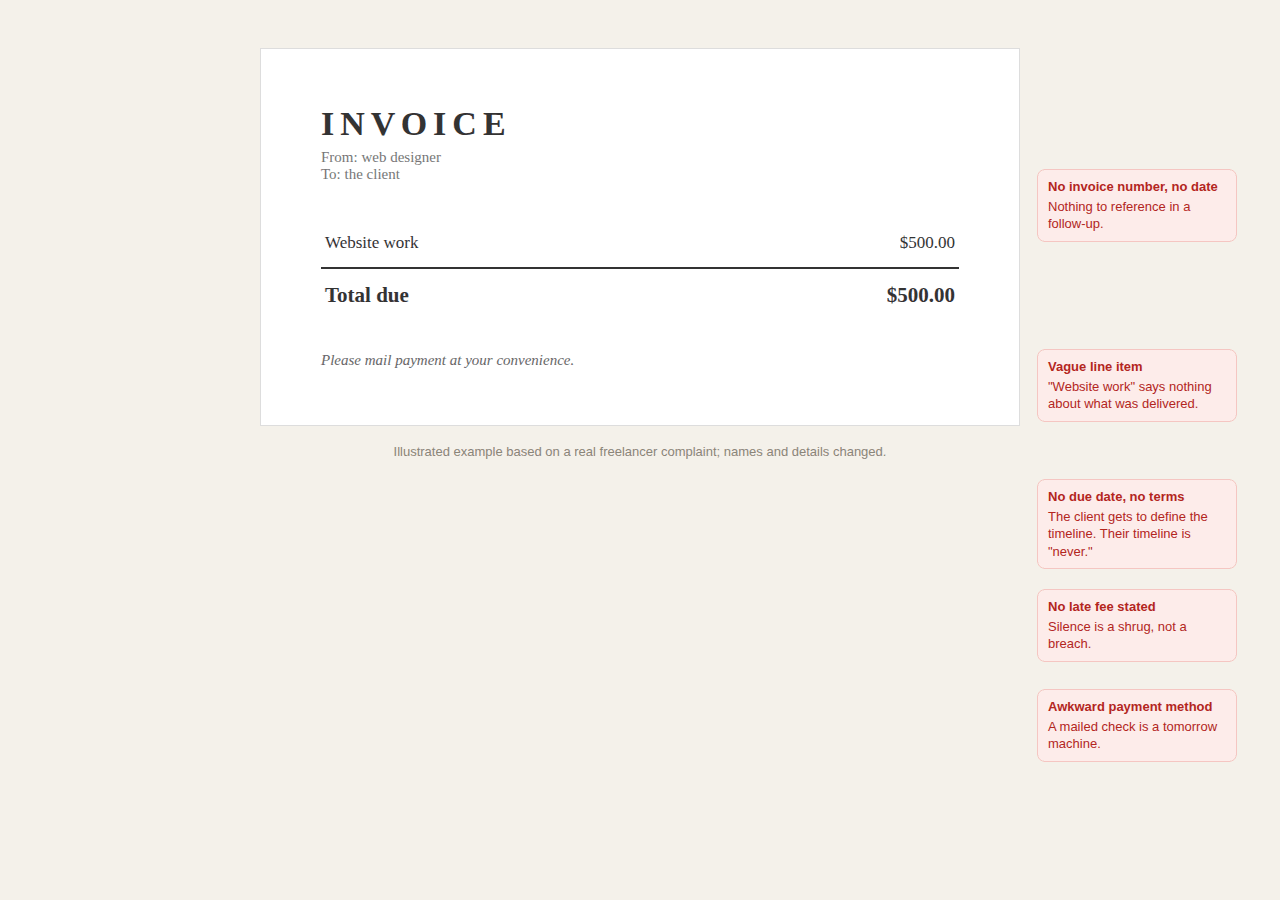
The invoice that waited: one vague line, no terms, no due date. Illustrated from a real complaint; details changed.
1. No deposit up front. The entire job was done on trust. A 50% deposit up front cuts your exposure in half and, more importantly, changes the relationship: a client who has paid something is a client who is committed. The no-deposit invoice at the end is always the hardest one to collect.
2. One invoice for the whole job. A single invoice after delivery means one big decision to pay, at the exact moment the client has everything they need from you. Milestone billing splits the job into smaller, easier decisions: half to start, half before handoff. Each paid milestone is a client recommitting.
3. No written terms on the balance. When did the $500 become due? What happens if it is not paid? With nothing stated, the ghosting client gets to define the timeline, and their timeline is "never." A due date plus a stated late fee does not guarantee payment, but it turns silence into a breach instead of a shrug.
4. Delivery before payment, with nothing held back. The finished website went over before the balance was settled. That was the last leverage the developer had, and it left with the deliverable. Staging links, watermarked previews, launch-day unlocks: these are not tricks, they are how professionals hand over work before the final payment clears.
5. Money came up for the first time in the invoice. The terms were never a conversation, so the invoice became a negotiation instead of a receipt. Every awkward money talk you avoid before the work becomes a harder money talk after it.
The fixed version
QUOTE
Website build: $800
Deposit due to begin work: $400
Balance due on delivery, before launch: $400
Payment terms: Balance due within 7 days of delivery. Late payments accrue a 1.5% monthly fee. Deposit is non-refundable once work begins.
Invoice 1 of 2 covers the deposit. Invoice 2 of 2 covers the balance, sent when the site is staged for review, payable before the launch.
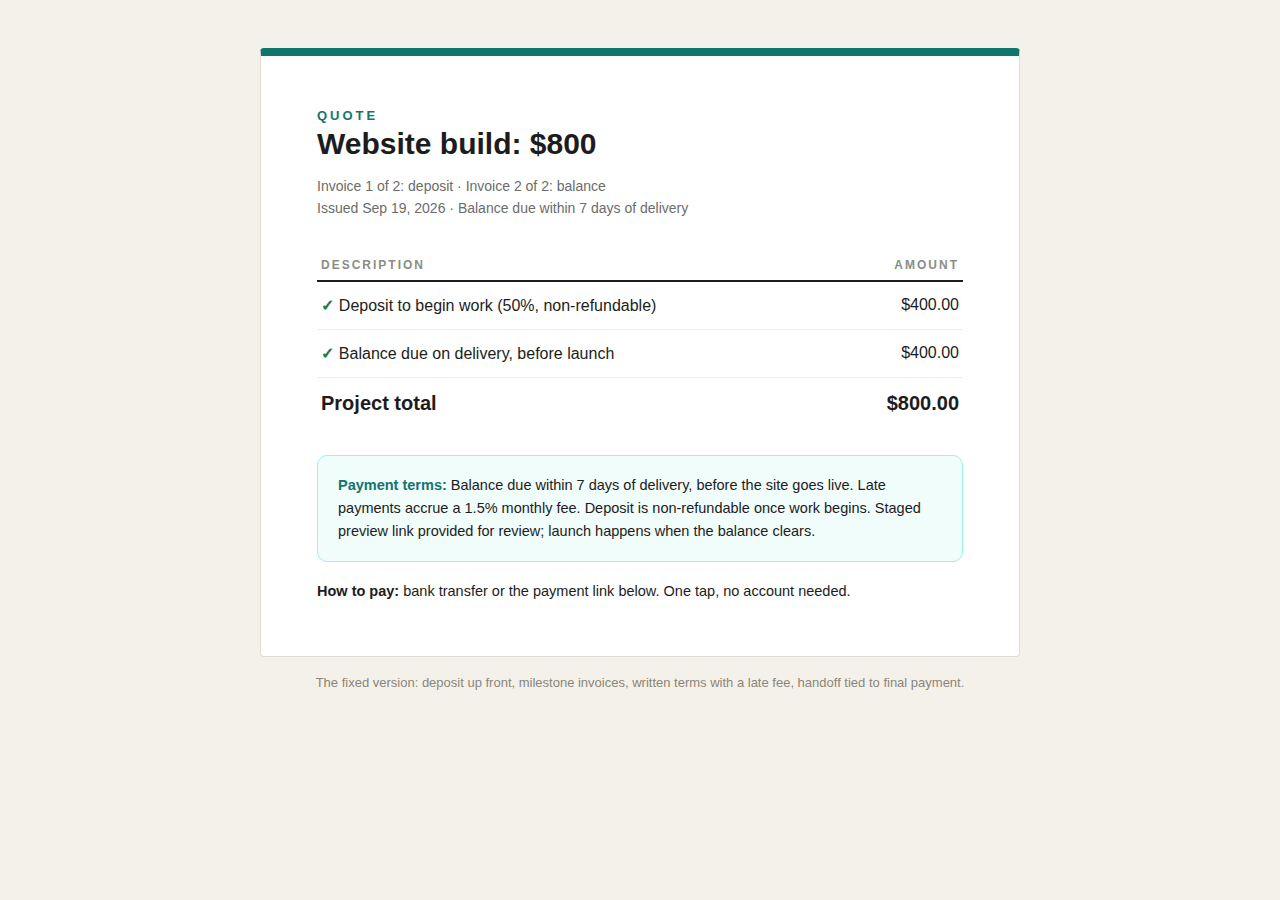
The fixed version: deposit up front, milestone invoices, written terms with a late fee.
Same work, same $800. Four changes: a deposit up front, milestone invoices instead of one bill at the end, written terms with a late fee, and handoff tied to the final payment. The $500 would never have become a gamble, because the money would have been settled before the work shipped.
The lesson
Never let the invoice be the first time money comes up. Deposits, milestones, and written terms settle the money question while you still have leverage: before the work ships. An invoice should be the receipt for a decision the client already made, not the start of a negotiation.
You can see deposits, terms, and milestones on a live invoice here: https://monkeetools.pages.dev/demo/
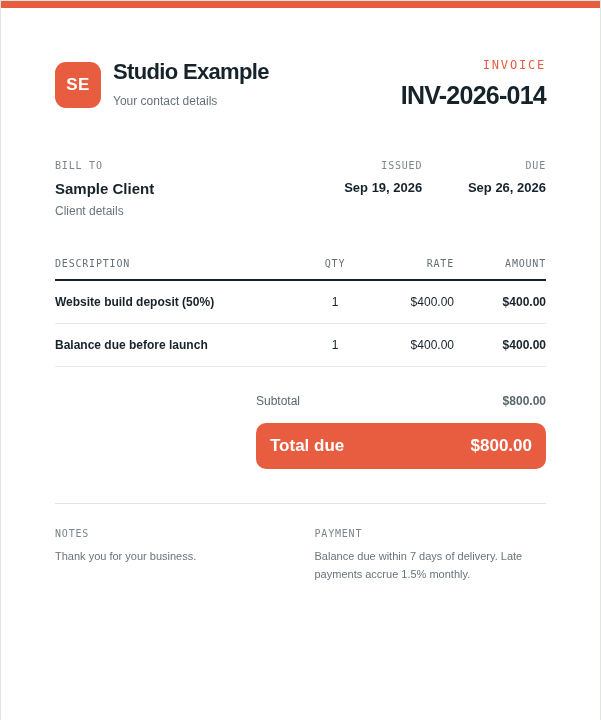
Payment terms live on the invoice itself, in the generator's payment section.
Get new posts by email.
One post a week: honest build logs and leverage-through-technology pieces for freelancers and bootstrapped founders. No spam, unsubscribe anytime. Subscribe on Substack.