
Blog
Originally published on Substack
Getting paid faster
Most freelancers do not have a deadbeat-client problem. They have a paperwork problem.
The work gets done. The invoice goes out. And then nothing. A week passes, then two. The client is not angry and nothing is disputed. They just have not paid. Meanwhile, rent is due.
Late payment is usually not about the client. It comes down to three things that were never settled before the work started: when payment is due, what happens if it is late, and how much is owed up front. Sort those out and most of the chasing disappears.
Here is the plain-English version. No accounting degree required.
1. Put payment terms on the invoice, in words a human would say
"Net 30" means the client owes you within 30 days of the invoice date. "Due on receipt" means now. Many freelancers leave terms off entirely, or paste in language from a template they do not fully understand.
Pick terms and put them where the client sees them before the total, not buried in fine print. Shorter terms are better. Net 7 beats Net 30, because a 30-day window tells the client this is not urgent, and they will believe you.
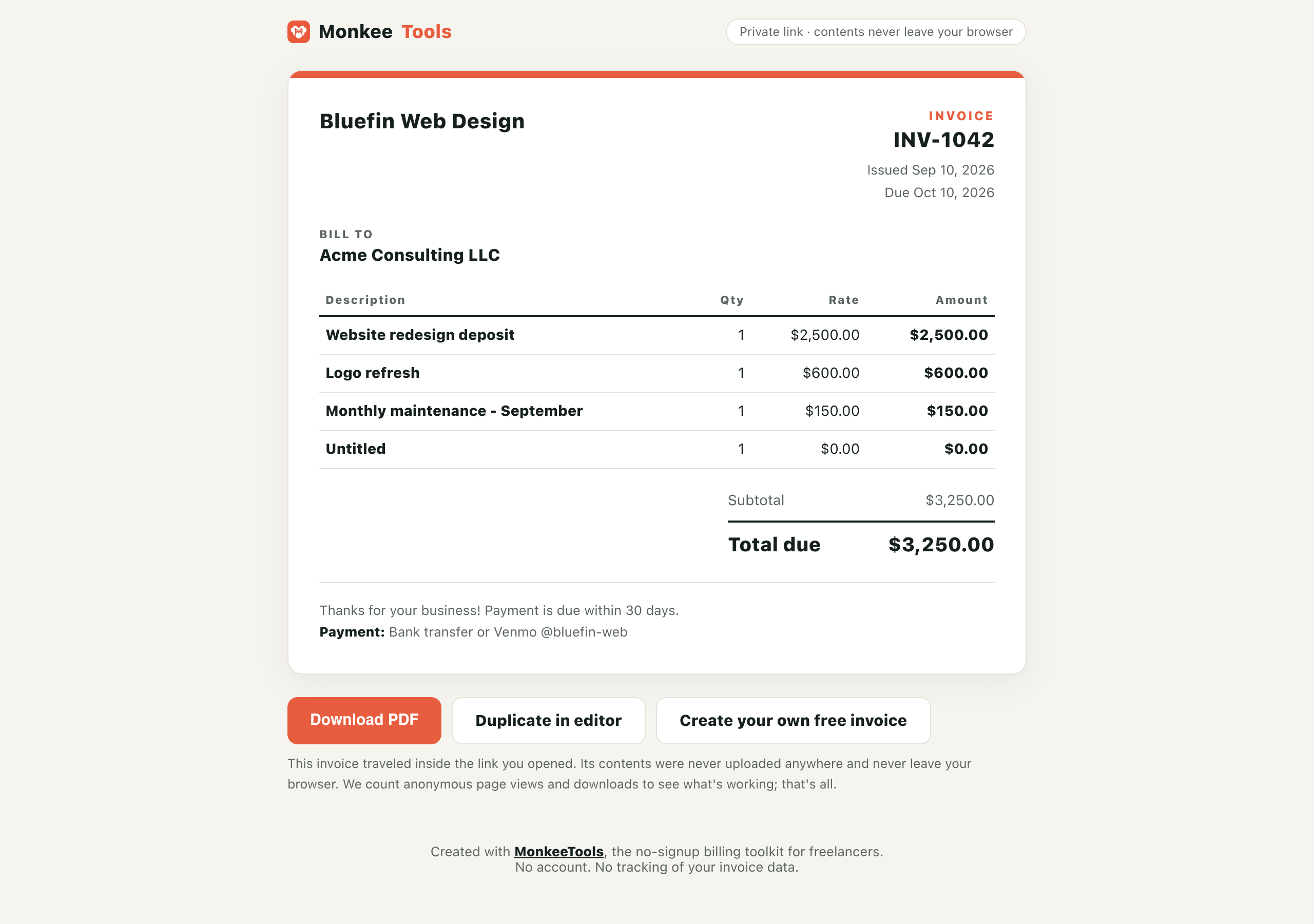
In MonkeeTools, payment terms are a field on the invoice itself, right in the payment section, so the client reads them in the same glance as the amount. You can see exactly what that looks like on the live demo invoice: https://monkeetools.pages.dev/demo
/
2. Take a deposit from every new client
A deposit does three jobs at once. It proves the client can pay. It proves the client will pay. And it means that if everything goes sideways, you are chasing the remainder, not the whole fee.
New clients are where the risk lives. With a repeat client you have history. With a new one you have hope. A deposit converts hope into evidence. Even a modest one changes the dynamic: the client has skin in the game from day one.
The invoice generator ships with a Deposit line item preset, an upfront deposit credited against the final invoice, so adding one takes a click instead of a manually typed line.
3. State the late fee before the work starts, not after it is late
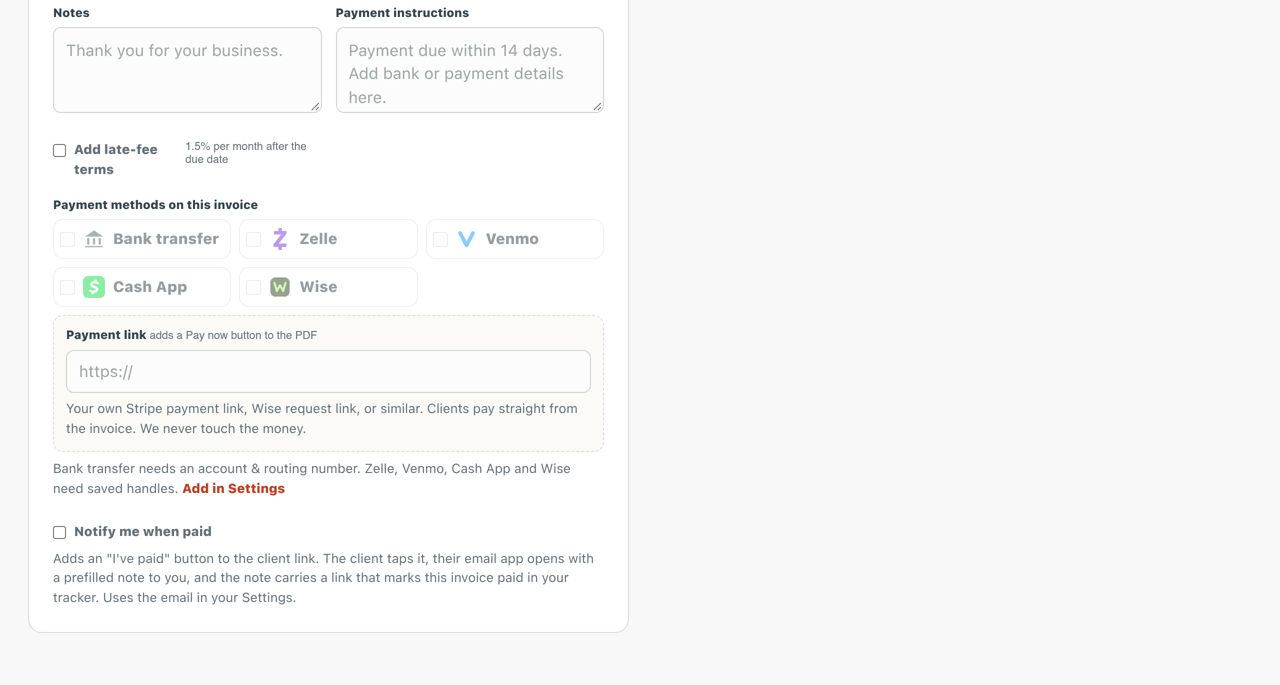
A late fee only works if the client agreed to it up front. Springing one on a client after they are already late feels like a punishment, and it reads like one, because it is one. Put the fee in the payment terms on the original invoice: a flat amount or a monthly percentage, your call, kept reasonable.
The fee's real job is not collecting fees. It is making the due date feel real. A due date with no consequence is a suggestion. A due date with a stated fee is a deadline.
And when a payment does slip, the polite chase email the tool drafts for you pulls the accrued late fee straight from the terms you set. You are quoting your own agreement instead of making an awkward demand
.
4. Make paying take less effort than ignoring you
This is the lever everyone underestimates. Every extra step between your client and the money is a reason to do it tomorrow. A PDF attached to an email that says "let me know if you have questions" is a tomorrow machine.
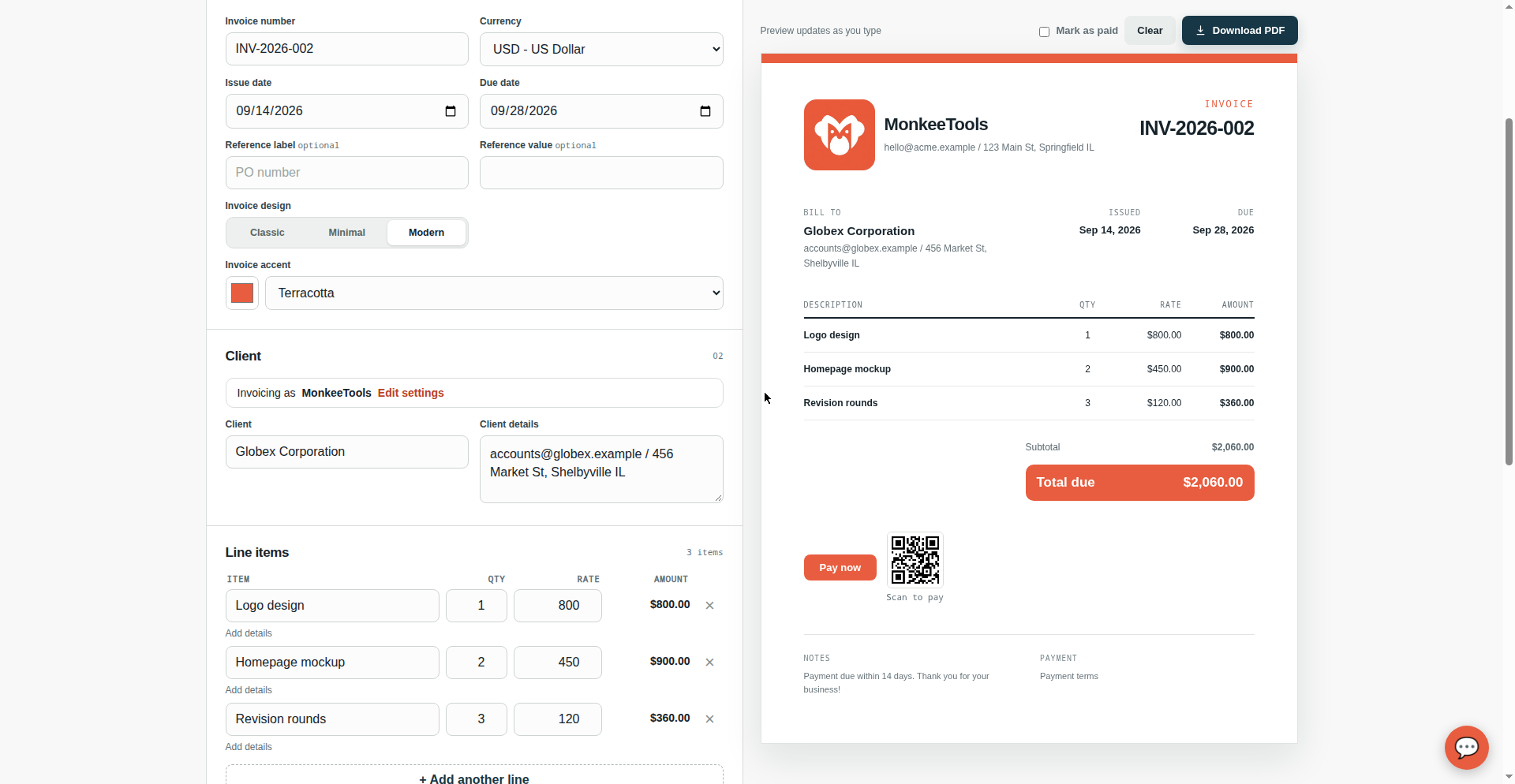
Put the way to pay on the invoice itself: a payment link, a QR code, a Pay now button the client can tap on their phone. When the client pays, they can mark the invoice paid themselves with one tap, so your records update without a round of "just confirming I sent it" emails. And when you do need to nudge someone, texting them a payment link beats emailing them a PDF every time.
That is what the demo invoice shows from the client's side: https://monkeetools.pages.dev/demo/ One page, the amount, the terms, and the ways to pay, all in one place
.
The pattern
Terms, deposit, late fee, easy payment. None of this is clever. It is deciding the money details before the work starts instead of after, and removing every excuse between the client and the pay button.
You can do all four of these with a pen and a spreadsheet. But if you would rather have the invoice remember your terms, calculate the late fee, draft the chase email, and track who has paid without keeping a ledger in your head, that is what the invoice generator is for: https://monkeetools.pages.dev/
No signup. Your data stays on your device. Just the invoice, and the money landing.
Get new posts by email.
One post a week: honest build logs and leverage-through-technology pieces for freelancers and bootstrapped founders. No spam, unsubscribe anytime. Subscribe on Substack.